


Here’s the reality: This fall, Iowans will vote on whether to raise the state’s sales tax.
The special interests proposing a new change to the Iowa Constitution won’t tell you that, but it’s true.
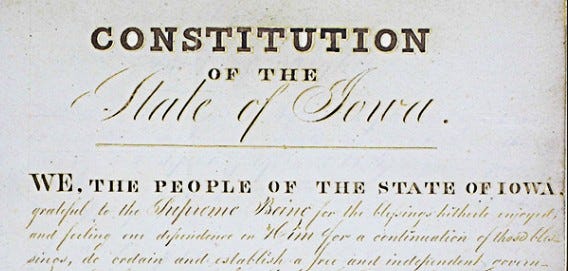
Technically, they’ve put a proposal on the ballot this November to make it almost impossible to raise income and corporate taxes by requiring a 2/3 super-majority in the state Legislature.
Some might see this as a defense against politicians raising your taxes, but it’s not. It just sets up a future increase in the state sales tax—and protects millionaires in the process.
The evidence is clear.
Iowa’s budget is a mess. We had a $1 billion budget deficit this year, and next year, we’re facing another $1 billion deficit. Who knows how much longer we can stay on this trajectory. If revenues don’t catch up with spending soon, the Legislature will have to raise more money. It’s that or starve public schools even more than they have been. Which seems unlikely.
That means a sales tax increase.
Why do I think that?
Because that’s what Iowa’s politicians have been doing for 40 years.
In 1983 and 1992, the state ran into budget problems, too. Both times, the solution was to raise the sales tax. Since then, the sales tax has continued to rise to cover government expenses, whether at the state or local level. In most places, the sales tax is now at 7%. That’s more than double what it was in 1982. Meanwhile, Republicans in the Legislature have dramatically cut income taxes for the rich.
What this has done is transfer more of the state’s budget burden to the poor and middle-class. Think about it: The poorest 40% of Iowans pay about 6% of their income in sales and excise taxes. The richest Iowans pay just 1%. Meanwhile, Iowa is relying far more on the sales tax than it used to in order to pay the bills. In 2019 Iowa raised $2 billion more in individual and corporate income taxes than it did from the sales tax. But six years later, they’re practically even.
The bottom line is this: The rich are being asked to do less. The poor and middle class are being asked to do more.
A yes vote on this amendment will continue that trend.
Other parts of the country are rejecting these kinds of unfair tax policies. They want the rich to pay their fair share.
In California, there’s a ballot referendum this fall to tax the wealth of billionaires.
In Washington state, the Legislature just approved a special tax on millionaires.
Maine did, too.
Americans support this trend. Polls show they don’t believe the rich are paying their fair share. They want a change.
In the face of these headwinds, the wealthy are trying to protect their gains in Iowa. They want to stop the people from reversing the flat tax that slashed income taxes for millionaires almost in half, while regular Iowans only got a 30% cut. At the same time, they’re purposely excluding the sales tax from special protection. As a result, it will be easier to raise.
Terry Branstad once described the sales tax as the least objectionable of Iowa’s major taxes. Which might be why politicians have been so willing to raise it. And as far as I can tell, they’ve never paid a political price for doing so. But we’re paying the price. Last year, the sales tax raked in about $4.4 billion. (This includes some hotel/motel tax proceeds). That’s more than $1,300 per Iowan.
Do we really want to raise the sales tax again? Because that’s what will happen if the special interests are successful at making it so a minority in the Legislature can block Iowans from asking the wealthy to pay more.
This week, we watched Iowa primary voters go to the polls to pick their candidates for the general election ballot. And judging by the first couple of days afterward, the Senate and governor’s races are going to be barn burners.
These are important races. The media will pay a lot of attention to them. But this proposed constitutional amendment is important, too, and so far, there has been hardly any coverage of the stakes involved.
If this question doesn’t get adequate attention, in the media and from an organized opposition, regular Iowans will be subjected to a boatload of misleading ads that falsely claim all this proposed amendment does is stop the government from raising taxes.
That’s not true. No Iowa lawmaker who wants to keep getting re-elected will raise income taxes on the poor and middle class. Not when the wealthy just got a huge windfall. That’s true whether this proposed amendment passes or not. So, who is it really designed to protect? Millionaires, that’s who.
If the supporters of this plan cared about you and me, they would have made it harder to raise the sales tax, too. That’s what they did during a similar effort in 1999. But they aren’t doing that now. This time, they want to protect the flat tax that helps the rich but make it easier to raise the sales tax that hurts the rest of us.
With any luck, Iowans will see through this scam and reject it.
Along the Mississippi is a proud member of the Iowa Writers Collaborative. Please check out the work of my colleagues and consider subscribing. Also, the collaborative partners with the Iowa Capital Dispatch, which provides hard-hitting news along with selected commentary by members of the Iowa Writers Collaborative. Please consider making a donation to support its work, too.
When is the Iowa legislature going to start legislating for the people of Iowa-the common good-rather than the rich and well connected and large corporations? Our great former governor, Bob Ray would be appalled.
THANKS FOR THE INFO ED, GREAT WORK. IOWA VOTERS MUST DO TWO THINGS COME NOVEMBER; FIRST REJECT THE SALES-TAX INCREASE--WHICH HURT THE LOW AND MIDDLE-INCOME CLASS THE MOST. AND SECOND THEY MUST VOTE OUT EVERY GOP POLITICIAN WHO CATERS TO ONLY HELPING THE WEALTHY--WHILE THE REST OF IOWA LIVES PAYCHECK-TO-PAYCHECK. ALSO IF THEY NEED MORE MONEY RAISE THE MINIMUM WAGE TO $15.00 AN HOUR.