

Back in May, I warned Iowans not to be too impressed by the actions of the 2026 Legislature. Election year pronouncements by politicians, I wrote, were bound to be overstated and out of touch with reality.
Turns out, I was right.
New reports say the estimated savings to taxpayers from Iowa’s much-ballyhooed property tax cut are coming in much lower than promised.
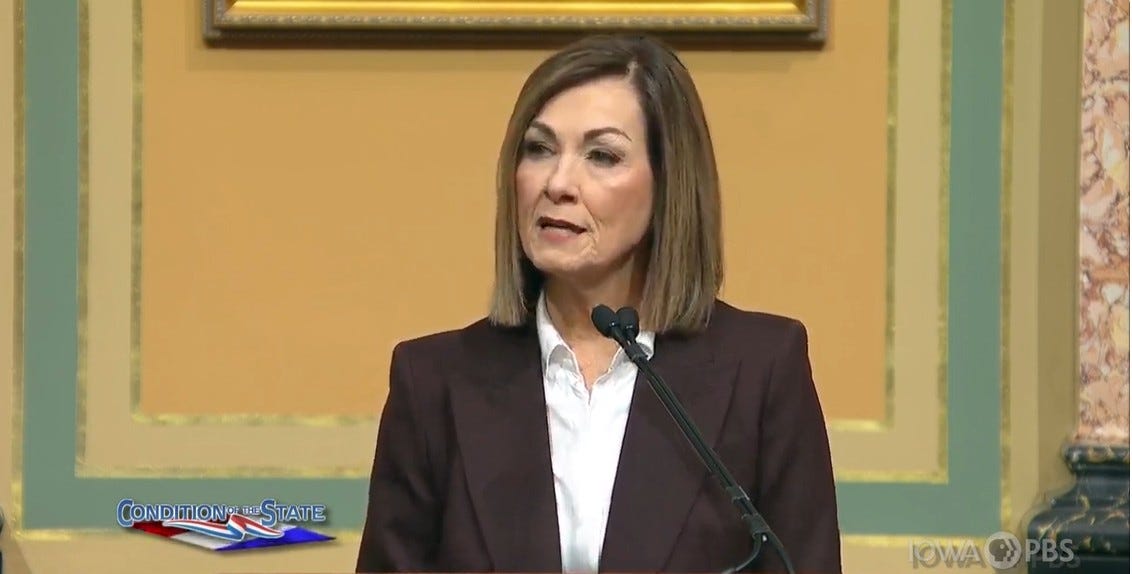
When Gov. Kim Reynolds signed the measure into law in May, she bragged the tax cut would save homeowners $4.2 billion over six years. But a report last month by the non-partisan Legislative Services Agency estimated the impact would be just $1.5 billion over four years. And Common Sense Institute Iowa, which highly praised Iowa’s property tax law, estimated in a new study that the cumulative savings would be about $2.5 billion through year six.
That’s 40% less than what Reynolds promised.
This is not surprising. The governor tends to overpromise in election years and underdeliver the rest of the time.
In 2024, when lawmakers passed their first increase in starting teacher pay in 11 years, Reynolds boasted Iowa would “soar to the top five in the nation.” Other Republicans echoed this claim as they sought re-election.
This turned out to be nonsense.
As I reported earlier this year, rather than soaring to the top five, starting teacher pay in Iowa limped along to 24th place in the nation, according to the National Education Association’s authoritative teacher pay survey.
To be sure, this was an improvement over our previous ranking of 46th place, but it fell far short of the GOP’s promises—and who knows how far Iowa will fall by the time the Legislature gets around to passing its next pay increase. Will it be another 11 years? Will we again fall to 46th place?
This is the way it is with Iowa Republicans—and with this governor in particular. They promise transformative change but fail to deliver the goods, except to select groups.
Here is a good example: A few years ago, Iowa Republicans delivered big income tax changes, and the richest Iowans made out big time. Unfortunately, the rest of us got the short end of the stick.
The conversion to a flat income tax won high praise from rightwing anti-tax groups and editorialists, but a state report at the time estimated the tax cut would deliver roughly the same amount of savings to the 10,000 richest households in the state as it would to the more than 400,000 Iowa families making between $30,000 and $90,000 per year.
Meanwhile, the conversion to the flat income tax has forced Iowa to rely more on sales and use taxes to pay the bills. These taxes come disproportionately from low- and middle-income families. Now we’re learning the property tax cut that was supposed to benefit all of us is failing to live up to expectations, too.
I don’t doubt Iowans will see some savings, although I wish the Legislature hadn’t taken a one-size-fits-all approach that will hurt responsible local governments over ones that weren’t so thrifty. Still, it’s shocking that the governor’s promised six-year savings would shrink by 40% in just three months.
Mind you, the estimates I cite were not created by some liberal group, or by Democrats, but by a non-partisan state agency and a business-friendly group.
Incidentally, Common Sense Institute ranked Iowa’s property tax law the best in the country. But not all states were included on its list. Citing the state of New Jersey, the institute said it paid for its property tax relief program with general fund dollars. Because of the backfill, the institute counted it as providing “no net tax relief at all,” excluding it from the list. Other states’ reforms weren’t included for the same reason.
Other policy groups, however, prefer a different approach. They say more targeted property tax relief best helps homeowners—and even renters—whose incomes aren’t able to keep up with rising taxes and housing prices. Tax caps, like the one in Iowa’s new law, on the other hand, give their biggest benefit to the owners of homes with the highest values, they say.
Some might argue it’s logical these homes get the biggest tax breaks because they have higher values. But multiple studies across the country have shown the owners of lower-valued homes are being punished by the property tax system. That’s because their homes are assessed more for tax purposes relative to their sales price than are higher-valued homes.
This shouldn’t be surprising. Overall, Iowa’s tax system asks low- to moderate-income Iowans to pay a greater share of their incomes in state and local taxes than it does the wealthy.
I should note that, in a news release, Reynolds touted Common Sense Institute’s ranking, but she conveniently ignored its lower overall savings estimate. Instead, she continued to use her own inflated number. This should tell you how honest Reynolds is with Iowa voters.
Let’s be clear: Iowa’s new property tax cut is exceedingly complex. Even the Legislative Services Agency says its estimates are subject to change.
This is a good thing to remember when some politician, even one not running for re-election, boasts that Iowa’s new law will save you boatloads of money. My advice is this: Believe it when you see it.
Along the Mississippi is a proud member of the Iowa Writers’ Collaborative. Please check out the work of my colleagues and consider subscribing to their newsletters. The Collaborative also partners with the Iowa Capital Dispatch, which provides Iowa news and commentary, including by members of the Iowa Writers’ Collaborative. Please consider making a donation to support its work, too.
Thanks for your watchdog efforts, Ed!
Thanks for this perspective, Ed.